Case Study
InformXR Case Study

Designing an enterprise XR analytics platform that turned 3D user behavior into decisions.
Designing an enterprise XR analytics platform that turned 3D user behavior into decisions.
InformXR is an enterprise analytics platform purpose-built for virtual reality training. I joined as the founding product designer to shape the product from an early research prototype into a production SaaS platform used by 40+ enterprise customers. I owned the end-to-end experience from discovery research and information architecture, through interaction design, to the design system that scaled across publishers, admins, and enterprise learners. The work led to acquisition by ArborXR in 2024, where InformXR now powers analytics for 500+ LMS deployments worldwide.
Enterprise XR training was exploding, but the people building and buying it had no way to measure it. Publishers shipped experiences and prayed. Enterprise L&D teams paid six figures for headsets with zero visibility into whether learners actually completed, engaged, or improved. The entire category was flying blind.
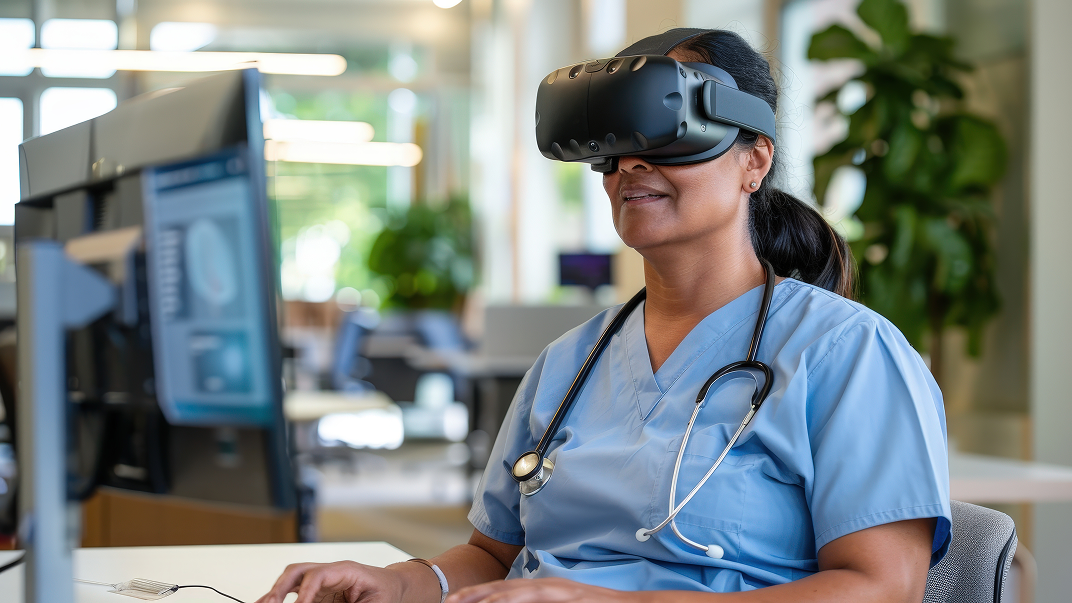 XR in Nursing Education
XR experiences had no equivalent to web analytics, publishers instrumented ad-hoc events with no common schema.
Enterprise admins couldn’t answer the most basic question: “Did this employee finish the training?”
Heat-maps and session replays existed in academic tools, but none were packaged for business decision makers.
XR content lived outside enterprise learning systems creating reporting gaps and zero accountability.
InformXR had to serve two very different audiences on top of the same data: the XR publishers who instrument experiences, and the enterprise buyers who consume reports. Every design decision had to answer “which reading order does this serve first?”
When I joined, Metalitix was the only competitor with meaningful traction in XR analytics. They were research-first, built for academics and Unity devs, and treated the enterprise buyer as an afterthought. That gap became our wedge: we would own the enterprise report layer while staying developer-friendly underneath.
Nobody had a mental model for what XR analytics should feel like. The product manager and I started on kraft paper taping up user flows, event schemas, and dashboard wireframes then pulled the best structures into a shared FigJam that the whole team could iterate against. Strategy had to precede pixels.
Kraft-paper mental model — physically mapping publisher flows alongside enterprise reading orders to find structural overlaps.
Flow mapping across publisher, admin, and learner journeys — collapsing shared screens into a system-generated IA.
Weekly hypothesis reviews with engineering — validating feasibility before committing a single hi-fi screen.
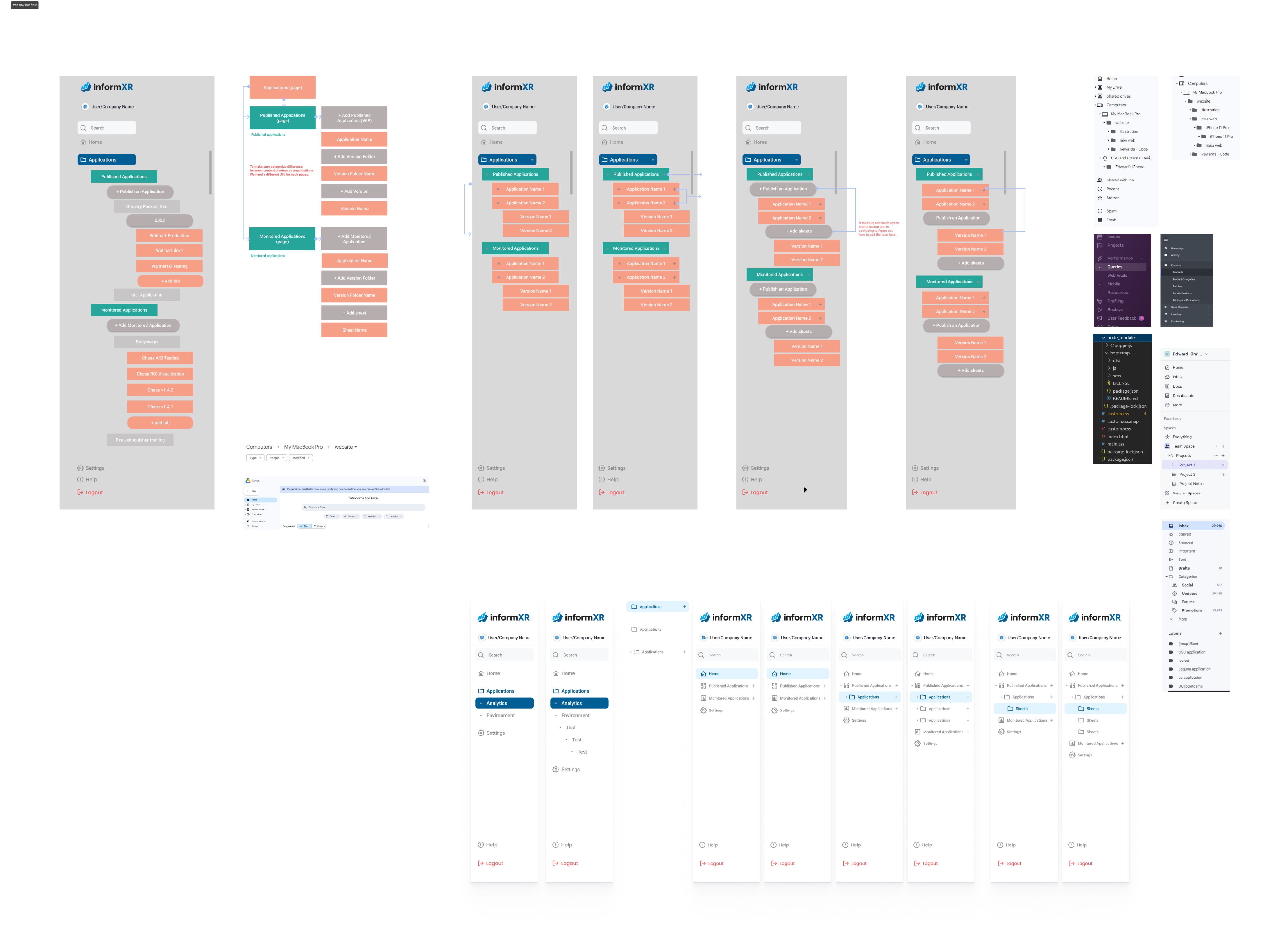
InformXR’s final shape came down to four non-obvious calls each trading short-term simplicity for long-term leverage. These are the calls that made enterprise adoption (and the acquisition) possible.
A single IA that publishers read bottom-up (events → sessions → experiences) while enterprise admins read top-down (org → program → completion).
Dashboards weren’t hand-authored screens, the IA was generated from event schemas, so new publisher content created new views automatically.
Role hierarchy (Org → Workspace → Project → Member) designed to match how Fortune 500 L&D departments actually buy and deploy.
Chart, table, filter, and metric-card primitives versioned like a design system, so every new report shipped in days, not weeks.
In 2024, ArborXR, the leading enterprise XR device management platform, acquired InformXR to become their official analytics layer. Shortly after, the combined platform was named a Meta Preferred partner for enterprise learning analytics. The design system I built now powers reporting for 500+ LMS deployments and is being referenced as the category template for XR training measurement.
InformXR became ArborXR’s official analytics product line within 60 days of close.
Named a Meta Preferred partner for enterprise XR learning analytics.
Design system scaled into ArborXR’s product family without a rebrand — primitives survived the merger intact.
Enterprise buyers cited InformXR reporting as a primary reason for fleet expansion post-acquisition.
InformXR grew from a research prototype into a category-defining product. The design system scaled with the company through acquisition and into ArborXR’s enterprise fleet.